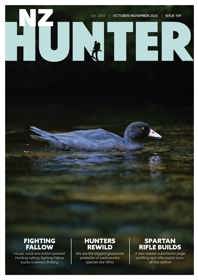
Issue 115 - October November | On Sale Monday 12th October

.jpg?width=900&height=675&mode=crop)


The election lolly scramble is well and truly underway now
It’s almost painful listening to the media who delight in setting up endless squabbles and point scoring between parties. The good thing is that National and its coalition partners did get some significant wins for sensible pragmatic hunting and conservation across the line in this last term with the establishment of hunter led management for both the Wapiti and Sika. And several parties have included some more sensible solutions to further pragmatic conservation after the election.
Unfortunately recently we’ve seen Federated Farmers take a leaf out of Forest and Bird’s book and run a massive polarising campaign about deer as pests and the effect on farmers and expecting the taxpayer to do something about it. Deer to farmers who don’t want them are no different to what birds are to grape or cherry growers, deer or goats to forestry companies, or any other organism that is seen as a pest to a particular primary industry. For all other sectors they expect to and do deal with pests that come on to their land as just one of the costs of production, and do not expect the taxpayer to foot the bill. In some cases a few farmers have compounded the problem by not allowing hunters on their land to control the deer, or even released the deer themselves. And other farmers don’t want the deer gone at all, as they make good money out of them, as well as tahr, so they protect and manage them as a resource – another very valuable part of their farming income.
If a farmer feels he has too many deer on his property and wants them gone, then there are really only two options – either hunt them via various means and keep hunting them if they come back, or fence them out if they are coming from a neighbouring farm, forest or public conservation land (PCL). And it’s not as expensive as some might think, a 2-wire electric top up fence works really well at keeping deer out at a comparatively reasonable cost compared to a full blown 2m high permanent deer netting fence. And it’s a one-off expense, not like bird netting on grapes for example which has to be put on and off every year at considerable cost.
As usual, it’s more of the “all deer bad” diatribe with no mention of the values of different species, sexes, ages and locations – just more of the failed deer menace rhetoric and policies of the past that has lead us to where we are right now.
And Feds also have accused recreational hunters of not being able to control deer, (another leaf out of Forest & Bird’s book) which is totally unfair gaslighting. Deer are currently treated only as pests, and they are controlled under the Wild Animal Control Act 1977 by the Department of Conservation and in some cases Regional Councils. (Except for the two HOSIs that have just been gazetted under the GAC Act)
Recreational hunters have almost never ever been allowed or given the job of managing/controlling deer. In fact the only place they have been allowed to do the job is the Fiordland Wapiti area, and that is the only example in the country of successful long term management with big wins for both hunting and conservation. And this year the NZ Tahr Foundation finally got permission after endless hurdles to be able to sell a single bull tahr hunt at auction in the USA and raised $50,000 for nanny control/management in Westland National Park, and after just one operation they are already quarter of the way to fulfilling the minimum number of nannies to be culled in their management permit. Both of these examples of hunter led management with excellent conservation outcomes are at no or minimal cost to the tax payer, yet have taken a huge fight to get across the line!
No one sensible is saying that recreational hunters can control deer and tahr everywhere, and certainly not just with their own “hands”. But the Fiordland Wapiti example proves that recreational hunters can manage/control deer in some situations where the animals they most value are preserved and managed, which they are then prepared to pay for the privilege of hunting in the prime time of the year. This money then pays for the female and herd reduction/management for the rest of the year. It’s an easy win/win by simply identifying and managing the animals of value, and not letting those most highly prized animals be taken by a boom bust WARO industry by only a handful of operators for short term private gain (until the venison price crashes again, as it has in the past due to a poison scare because someone took animals from areas they wasn’t supposed to). If those most valued animals on PCL are continually taken by WARO, it is to the detriment of the (by contrast) huge number of New Zealanders who value deer on PCL - recreational hunters - and also with dubious and inconsistent value to conservation because the WARO guys are not prioritising targeting the breeding hinds as they are less financially viable than the stags. We can’t blame them for that under the current open slather system, it’s purely economics.
Recreational hunters are the single biggest harvester of deer in this country, taking over 255,000 deer a year. WARO by contrast fluctuates from a high of about 130,000 in the deer recovery heyday of the 60s and 70s to zero in the 2000s and lows of as little as 5000 since then. Currently WARO numbers are rising again with the 25/26 year total of 56,000, but the vast majority are being taken on private land with only 8000 of those off PCL. And yet again there is no recognition given or priority to leaving those animals recreational hunters actually value, and the fact a low population of the right animals in the right places is a win/win for everyone – farmers, conservationists and hunters.
The latest from the Feds is they are saying they should not have to pay their share through their Ospri levy for the extra cost of deer repellent in aerial 1080 operations for TB control in the Kaweka Forest Park that is now part of the Sika HOSI. That is pretty rich considering the number of TB outbreaks from a minority of farmers legally and illegally shifting what turn out to be infected livestock around the country, and then TB gets into the local possum population. TB has never been found in either possums or deer in the Kawekas, and yet hunters are working constructively with Ospri and farmers to try and rid the neighbouring farming areas of TB. They have accepted the 1080 drops as necessary, and all they’ve asked is that deer repellent be used and the timing be as sensible as possible to get a maximum kill on possums with a minimal kill on deer - especially the highly valued stags in this extremely popular recreational hunting area that is now part of the Sika HOSI. Federated Farmers really do seem to be trying to alienate the very people they need to work alongside to get sensible deer control/management now and in the future in NZ – and it’s not only hunters who are really getting sick of this negative and counterproductive campaign - from the feedback we are getting plenty of sensible farmers are too. It seems to be more about manufacturing a problem to gain media attention rather than working constructively with the GAC and the game animal sector on managing game animals. This has to be the future going forward, a united nuanced for different places approach by all with an interest in deer that focuses on maximising their value while minimising their impact. It is really that simple!
A couple of corrections from our Leupold BX-6 testfire last issue: the BX-6 Range HD is covered by a 5-Year Electronics Warranty, which covers the rangefinding and electronic systems, along with Leupold's Lifetime Optical Guarantee covering the optical components, including the lenses, prisms, and coatings. It's also worth mentioning that these binoculars are supported much like a Leupold riflescope, with access to servicing (long after the electronic warranty is over) and after-sales support rather than being treated as a disposable electronic product. From a customer perspective, that's a significant benefit and an important point of difference in the premium optics market.
In this issue:
This issue we have...
06 – Two Vikings and an Axe | By Emil Hansen
12 – ANZAC Stag | By Josh Ferguson
18 – The Biggest Baddest 30 Cal | By Greg Duley
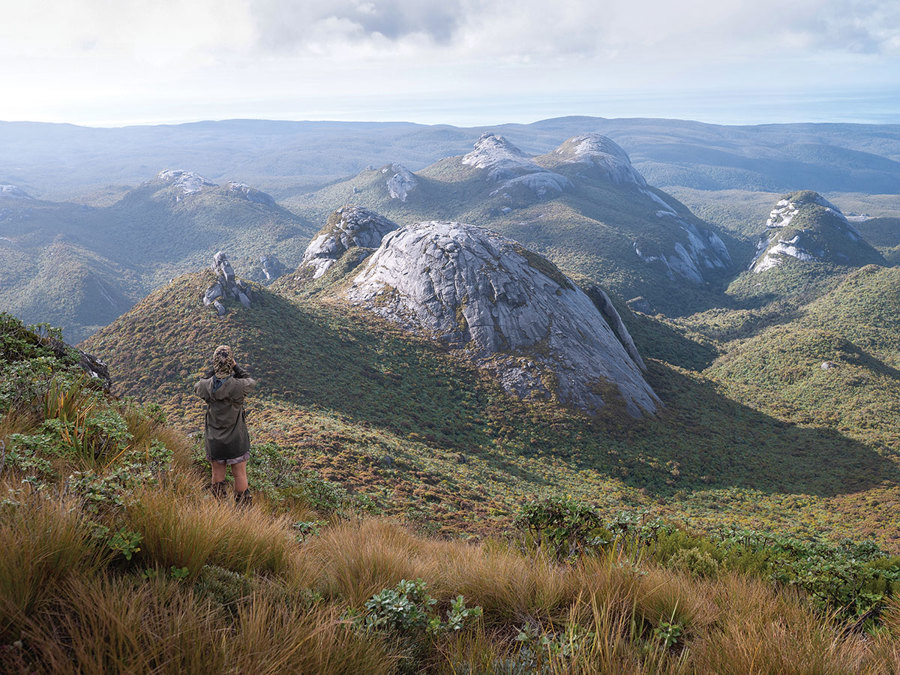
22 – Tin Range Traverse | Stewart Island Series Part Five | By Mitch Thorn
28 – Boars and Chamois from the North and South Part II | By Jonathan Fulton
32 – Broadhead Failure or Not | By Kevin Watson
38 – The Ultimate Hunting 4x4 | Part Four – Suspension | By Luke Care
42 – Hunters and their Luxury Camps Part II | By Greig Caigou
48 – Donald Shepherd - WithWild | By Hannah Rae
54 – The Foxhound | By Annabelle Latz
58 – Better Hunting – Hunt and Share | By The GAC
62 – Wild Edge 3 – You’ve Got This | By Hannah Rae
68 – Good News Stories – The Crouchleys | By Greig Caigou
72 – Remote Huts – Mt Greenland Hut | By Andrew Buglass
74 - GAC Update | By The GAC
80 – The Apprentice | By Corey Carston
102 – Whitetail Loin on Tomato Herb pasta | By Richard Hingston
Test Fires: We evaluate...
Surron Ultra Bee Electric Bike | By Luke Care
Garmin Xero L60i Rangefinder | By Greg Duley
Ruger 77/44 and Leupold DeltaPoint Pro | By Luke Care


.jpg?width=200&height=149.9&mode=crop)

e-magazine available online
You can purchase electronic versions of the magazine on ZINIO for viewing on the following devices: Rim, iPad, WebOS, Android, Win8, PC/MAC.
Buy the Printed magazine:
You can also easily subscribe to our original printed magazine plus if you are looking for older issues we can help you with that also.
Hunting for a Back Issue?